
English| EUR
Suggested for you
More currencies
Choose a language
Beijing Capital International Airport operates across three distinct terminals, each designed for specific airline groups and flight types. Knowing which terminal your flight uses—and how the terminals connect—determines how much time you need between arrivals and departures. This guide maps the airport's structure so you can move confidently through one of Asia's busiest hubs.
Quick answer
Beijing Capital International Airport has three terminals: Terminal 1 (domestic flights, limited carriers), Terminal 2 (domestic flights, China Southern and SkyTeam alliance), and Terminal 3 (international and domestic flights, Star Alliance and Oneworld members). Terminal 3 is the largest, spanning nearly 1 million square meters and handling the majority of international traffic. Terminals 2 and 3 connect via the Airport Express train, while Terminal 1 requires a shuttle bus.
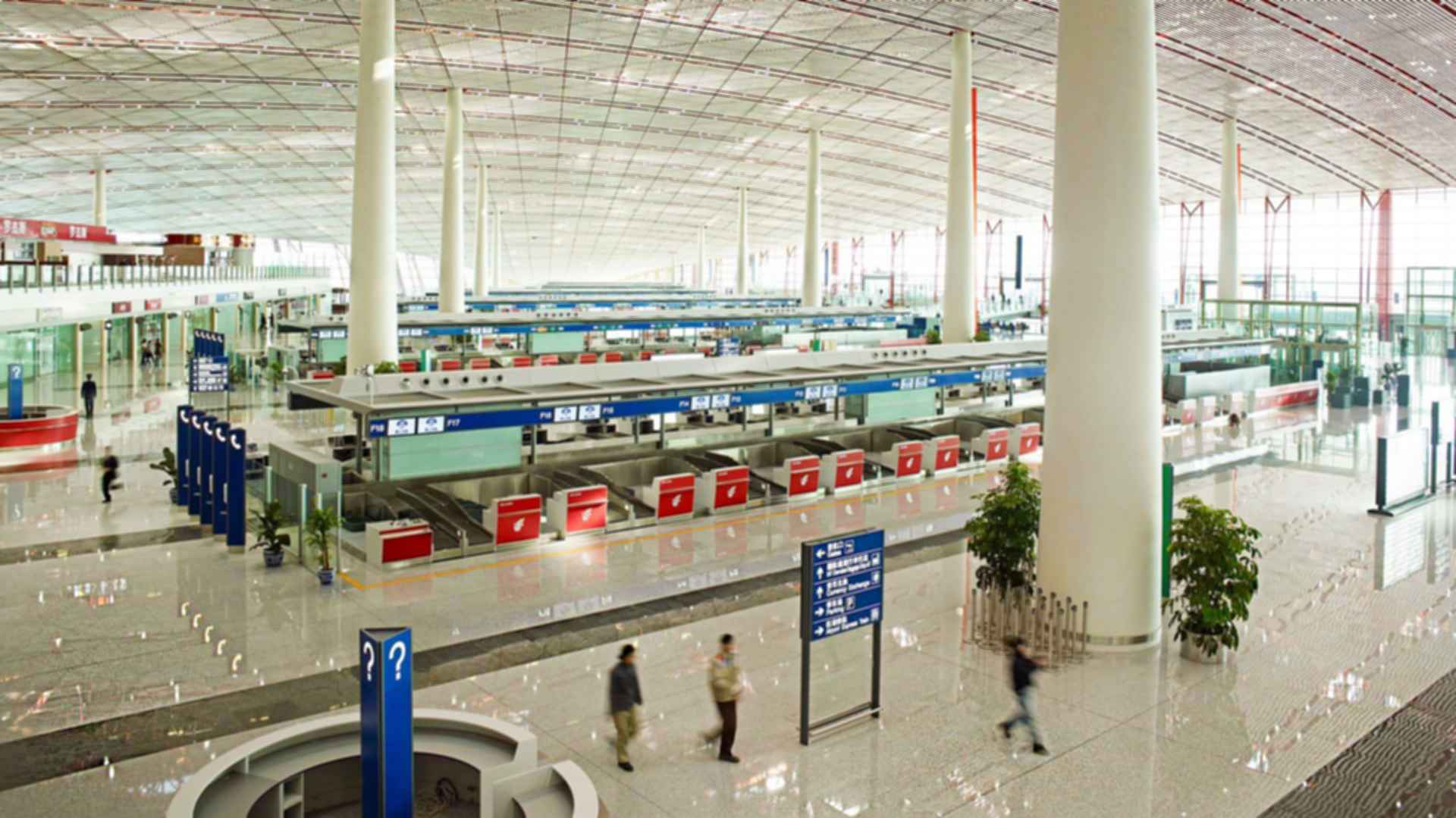
Beijing Capital International Airport spreads across 1,400 hectares northeast of the city center, and its three-terminal structure reflects decades of expansion to meet surging passenger demand. Terminal 1 opened in 1980 as the original facility, now scaled back to serve Hainan Airlines and a handful of domestic routes. Terminal 2 came online in 1999, accommodating China Southern Airlines and SkyTeam partners on domestic itineraries. Terminal 3, completed for the 2008 Olympics, transformed the airport into a global gateway—its red-and-gold lattice roof visible from approach patterns, its sprawling concourses designed by Norman Foster to handle 60 million passengers annually. Understanding Beijing Airport's terminal configuration matters most during connections. Passengers moving between Terminal 2 and Terminal 3 board the Airport Express train for a seven-minute ride, while those starting at Terminal 1 must take a free shuttle bus that runs every ten minutes. International arrivals funnel through Terminal 3's dedicated customs and immigration halls, where queues lengthen during morning European arrivals and evening North American banks. Domestic check-in counters at Terminal 2 occupy a compact footprint compared to Terminal 3's tiered layout, where airlines cluster by alliance—Star Alliance gates on the eastern pier, Air China's hub operation dominating the central spine. First-time visitors often misjudge transfer times because the terminals sit farther apart than terminal maps suggest. Walking between gates within Terminal 3 can consume twenty minutes, and the train ride between terminals adds another fifteen when you account for security re-screening. The airport provides clear bilingual signage in Mandarin and English, with color-coded wayfinding that assigns yellow to Terminal 1, blue to Terminal 2, and red to Terminal 3. Ground transportation—taxis, airport buses, the Capital Airport Express metro line—departs from each terminal's dedicated zone, so confirming your arrival terminal before booking onward travel prevents costly backtracking across the complex.
“Terminal 3's red-and-gold roof spans nearly a kilometer, a design built to process an Olympic city's surge into global aviation.”
Beijing Capital International Airport (PEK) operates using a three-terminal configuration to manage its significant passenger traffic. These terminals are functionally divided to handle domestic and international routes efficiently.
The airport functions with three distinct terminals, known as T1, T2, and T3, which are strategically organized to manage different airline operations.
Terminal 1 primarily serves domestic flights for specific carriers, functioning as the smallest of the three facilities.
Terminal 2 handles a mix of domestic and international services, acting as a central hub for various airlines operating within the SkyTeam alliance and others.
Terminal 3 is the largest facility at the airport, divided into three sub-sections: T3-C, T3-D, and T3-E.
The T3-E concourse is dedicated specifically to international and regional flights, connected to the main T3-C building by an automated people mover system.
The layout is designed to separate passenger flow by flight type, with T3-C serving as the domestic processing center for the airport's largest terminal complex.
Beijing Capital International Airport is located in the Chaoyang District and is accessible via a comprehensive network of rail and road transport. Navigation between terminals is facilitated by a dedicated free inter-terminal shuttle bus service and the Airport Express rail line.
Airport Express Line to Terminal 2 or Terminal 3
Airport Shuttle Bus to various city locations
Jichang West Road to terminal drop-off points
The airport operates 24 hours daily, but arriving early is recommended for check-in and security. Use the complimentary inter-terminal shuttle if your transit requires moving between Terminal 2 and Terminal 3.
Beijing Capital International Airport operates on a continuous schedule to accommodate passengers across all terminals. The facility remains open daily throughout the year.
Access to the terminal buildings at Beijing Capital International Airport is open to the public. There are no entrance fees required to enter or navigate the terminal facilities.
Verdict: A typical adult pays 0 CNY for terminal access, which remains consistent regardless of the terminal or time of day.
Confirm these details before traveling to Beijing Capital International Airport to ensure smooth navigation across its three terminals.
Everything you need to know about how many terminals does beijing airport have
Beijing Capital International Airport currently operates three main passenger terminals, known as T1, T2, and T3. Understanding how many terminals does beijing airport have is the first step in planning your transit through this major aviation hub.
Terminal 3 primarily hosts international carriers and several domestic airlines, including Air China. Travelers often wonder how many terminals does beijing airport have when checking their specific departure gate information for these major routes.
The airport provides a free inter-terminal shuttle bus service to connect passengers between T1, T2, and T3. Passengers should check their boarding pass to confirm their departure point, as knowing how many terminals does beijing airport have helps in calculating necessary transit time.
There is no entrance fee to access the public areas of the airport, as entry is 0 CNY. The facility is fully accessible to the public for travel and logistics purposes.
The airport is operational 24 hours a day, seven days a week, from Monday through Sunday. You can find arrivals and departures scheduled throughout the entire day.
While the airport is open 24 hours, the best arrival window is between 00:00 and 23:59. Arriving early is recommended to ensure you have sufficient time for check-in and security procedures.
Yes, the airport serves as a primary gateway for international air travel into China. Whether arriving or departing, verify your terminal gate to navigate the massive complex efficiently.
If you are transferring, it is essential to identify which of the three terminals your flight uses. Regardless of the transfer type, knowing how many terminals does beijing airport have ensures you can plan your connection effectively.